

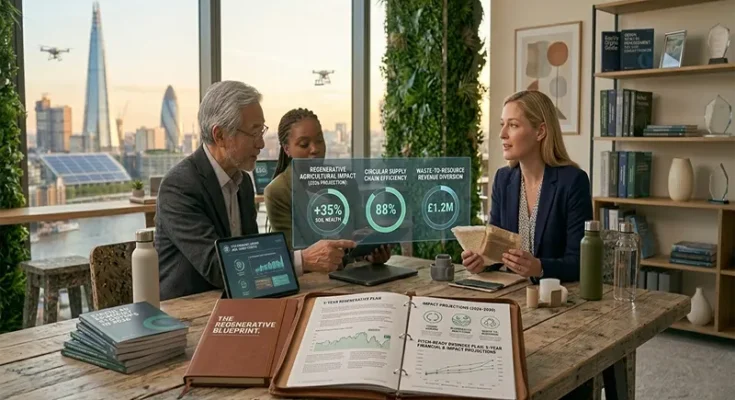
The Regenerative Blueprint: Building a Pitch-Ready Business Plan for Circular Economy Startups in 2026
By 2026, the global economy has hit a definitive inflection point. The traditional linear model of “Take-Make-Waste” is no longer just environmentally irresponsible; it is economically non-viable. Driven by hyper-volatile commodity prices, the EU Circular Economy Act, and the mainstream adoption of Digital Product Passports (DPP), startups that treat waste as a design flaw rather than an inevitability are the ones capturing institutional capital.
A business plan for a circular startup requires a fundamental shift in logic. It isn’t just a sustainable version of a standard plan; it is a reimagining of ownership, logistics, and value retention.
1. Defining the Circular Business Model: The Five Archetypes
In 2026, investors are looking for specific, scalable circular archetypes. Your business plan must explicitly state which loop you are closing.
- Circular Inputs: Using 100% renewable, bio-based, or fully recyclable materials that eliminate the concept of “virgin” resource extraction.
- Resource Recovery: The