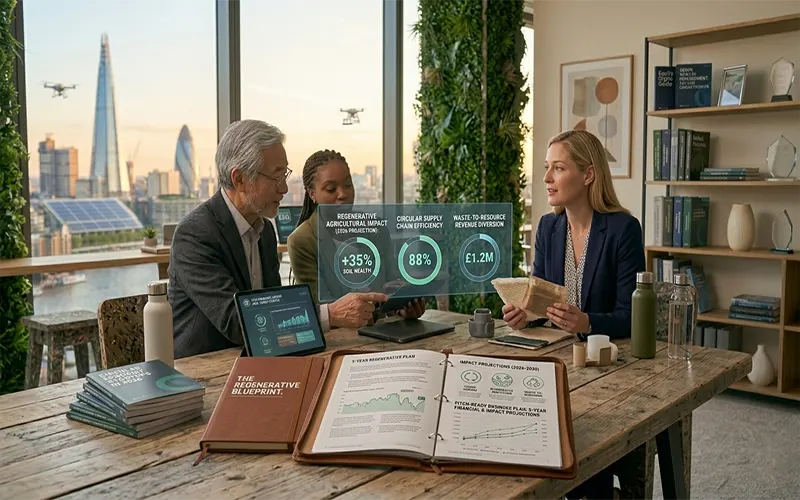
By 2026, the global economy has hit a definitive inflection point. The traditional linear model of “Take-Make-Waste” is no longer just environmentally irresponsible; it is economically non-viable. Driven by hyper-volatile commodity prices, the EU Circular Economy Act, and the mainstream adoption of Digital Product Passports (DPP), startups that treat waste as a design flaw rather than an inevitability are the ones capturing institutional capital.
A business plan for a circular startup requires a fundamental shift in logic. It isn’t just a sustainable version of a standard plan; it is a reimagining of ownership, logistics, and value retention.
1. Defining the Circular Business Model: The Five Archetypes
In 2026, investors are looking for specific, scalable circular archetypes. Your business plan must explicitly state which loop you are closing.
- Circular Inputs: Using 100% renewable, bio-based, or fully recyclable materials that eliminate the concept of “virgin” resource extraction.
- Resource Recovery: The “Urban Mining” model—recovering materials or energy from disposed products to create secondary raw materials.
- Product Life Extension: Capturing the “inner loops” of the circular economy through repair, upcycling, and remanufacturing.
- Sharing Platforms: Increasing the utilization rate of underutilized assets (e.g., heavy machinery or specialized electronics).
- Product-as-a-Service (PaaS): Shifting from selling a product to selling access or performance. The company retains ownership, incentivizing the creation of the most durable, repairable product possible.
Linear vs. Circular Business Logic
| Feature | Linear Model (Traditional) | Circular Model (2026 Standard) |
| Value Creation | Volume-driven (Sell more units) | Value-driven (Extract more use per unit) |
| Product Design | Planned obsolescence | Modular, repairable, and upgradable |
| Customer Relationship | Transactional (End of sale = End of link) | Relational (Continuous service/subscription) |
| Material Sourcing | Virgin materials / Global supply risk | Secondary materials / Localized loops |
2. Design for Circularity and the Digital Product Passport
A pitch-ready plan must detail how the product is engineered for its “next life.” In 2026, this is facilitated by the Digital Product Passport (DPP). Your plan should describe your DPP architecture—a blockchain or secure cloud-based ledger that tracks a product’s material composition, repair history, and recycling instructions.
Design Priorities:
- Modularity: Can a single broken component be replaced without discarding the whole unit?
- Disassembly: How many minutes does it take to strip the product down to its raw material components?
- Material Health: Proving that inputs are non-toxic and “safe for the loop.”
3. The “Reverse Logistics” Strategy: The Missing Link
The most common failure in early circular business plans was ignoring how to get the product back. In 2026, Reverse Logistics is the core of your operational plan. Investors will scrutinize your “Take-Back” infrastructure.
- Incentive Structures: Will you use deposit-return schemes, buy-back credits, or “Smart Contracts” that trigger a refund when a product is scanned at a recycling hub?
- Collection Points: Are you partnering with existing retail footprints, or utilizing a decentralized “Post-as-a-Service” collection model?
- Processing Hubs: Where does the “sorting and grading” happen? A circular startup is often a logistics company disguised as a product company.
4. New Metrics for Success: Moving Beyond ROI
Standard KPIs (Key Performance Indicators) often fail to capture the value of a circular business. To be pitch-ready, you must introduce “Circularity Metrics” that prove your resource efficiency.
- Circularity Rate: The percentage of secondary (recycled or reused) materials compared to the total material weight.
- Utilization Rate: For PaaS or sharing models, how many hours/cycles is the product active vs. idle?
- Value Gap Analysis: A critical 2026 metric that quantifies the economic value currently being lost to waste or underutilization in your industry, and how much of that gap your startup “plugs.”
- Product Lifetime Multiplier: How many times longer does your product last compared to the industry average linear alternative?
5. Funding and the “Green Premium” in 2026
The funding landscape for circularity has shifted from “Impact Investing” to “Risk-Adjusted Alpha.” Circularity is seen as a hedge against supply chain volatility.
- Sustainability-Linked Loans (SLLs): Your plan should mention seeking debt financing where interest rates drop as you hit specific circularity milestones (e.g., reaching 80% recycled content).
- Grants & Subsidies: Highlight alignment with 2026 frameworks like Horizon Europe or the US Circular Economy Innovation Act, which provide non-dilutive capital for “Deep Green” infrastructure.
- Supply Chain Resilience: Explain to investors how your model reduces “Geopolitical Risk” by sourcing materials from your own customer base (secondary loops) rather than volatile international markets.
6. The Management Team: The System Thinkers
A circular startup cannot be run by a traditional “siloed” team. Your business plan should highlight a team capable of Systems Thinking.
- Chief Circularity Officer (CCO): A role that bridges the gap between product design, supply chain, and marketing.
- Material Scientists: Experts who understand the molecular lifecycle of your inputs.
- Logistics Strategists: Veterans who can manage the complexity of two-way supply chains.
Waste as Unused Capital
By 2030, the word “waste” will likely be removed from the industrial lexicon, replaced by the term “Unused Capital.” A circular business plan written in 2026 isn’t just about being “green”; it’s about being the most efficient possible steward of resources.
Investors aren’t looking for a company that does “less harm.” They are looking for a company that is Regenerative by Design—one that grows more profitable with every loop it closes.