As of February 2026, the global urban landscape has entered the “Great Recalibration.” The traditional office sector, while stabilizing in “trophy” buildings, continues to face a widening divide, with lower-quality stock experiencing vacancy rates near 23% in many major metros. Single-use zoning—once the backbone of city tax revenue—is now a liability.
For property owners and municipal leaders, the path forward is no longer about waiting for a return to 2019 patterns. It is about Adaptive Reuse: the strategic conversion of underutilized commercial shells into vibrant, mixed-use ecosystems that combine living, working, and essential services into a single “15-minute” hub.
1. The 2026 Shift: Beyond Single-Use Zoning
The “Urban Doom Loop” fears of 2024 have been replaced by a more pragmatic reality in 2026. Cities like San Francisco, Chicago, and Phoenix have pivoted toward “Entitlement Smoothing,” passing ordinances that fast-track the conversion of commercial assets into residential and community spaces.
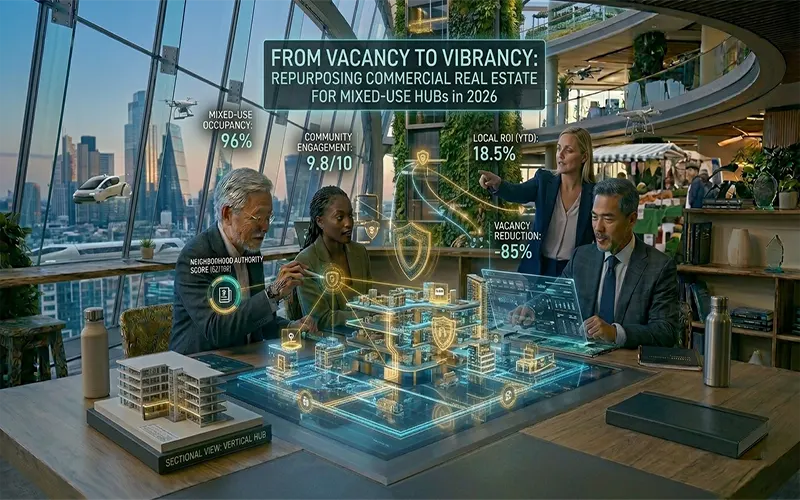
The goal is to move from a central business district (CBD) to a Central Social District (CSD). By integrating diverse uses, developers are diversifying their income streams, ensuring that a building remains active 24/7 rather than sitting dark after 5:00 PM.
Single-Use Risk vs. Mixed-Use Resilience
| Feature | Single-Use Office (Legacy) | Mixed-Use Urban Hub (2026) |
| Occupancy Pattern | Mon-Fri, 9-5 (Highly volatile) | 24/7 (Stable & Distributed) |
| Revenue Stream | Single Tenant Class | Multi-Stream (Residential, Retail, Wellness) |
| Footfall Driver | Mandatory Commute | Lifestyle & Convenience |
| Economic Buffer | Low (Susceptible to sector shifts) | High (Hedge against office downturns) |
| Asset Value | Facing obsolescence | Premium Valuation (High Demand) |
2. The Adaptive Reuse Framework: Navigating the “Core” Challenge
Converting an office building isn’t as simple as putting up drywall. In 2026, architects are focusing on the “Plumbing and Core” dilemma. Office buildings from the 1980s often have deep floorplates (the distance from the window to the elevator core), which creates “dark centers” unsuitable for traditional apartments.
Innovative 2026 Solutions:
- Residential “Slicing”: Creating “donut” configurations with central light wells or courtyards cut into the building’s center.
- Vertical Mixed-Use: Retaining the deep core for “amenity bunkers” (theaters, gyms, or climate-controlled self-storage) while keeping residential units on the window-rich perimeter.
- Live-Work Lofts: Utilizing open-plan office layouts to create oversized lofts that appeal to the 40% of urban professionals who now work in a fully remote or hybrid capacity.
3. The New “Anchor” Tenants: Medtail and Micro-Logistics
The 2026 urban hub has replaced the “Department Store” anchor with “Lifestyle Anchors” that drive consistent daily traffic.
- Medtail (Medical-Retail): Longevity clinics, urgent care, and specialized wellness studios (like infrared saunas and cold-plunge centers) are moving into ground-floor retail spaces, providing essential services to the residents above.
- Micro-Logistics & E-commerce Hubs: With urban delivery demands peaking, vacant basements or parking garages are being repurposed as “Last-Mile” delivery hubs and automated parcel lockers.
- Experiential Social Infrastructure: Childcare centers, community coworking lounges, and rooftop gardens are the “glue” that attracts high-quality residential tenants and justifies a 15–20% rent premium.
4. The 2026 Capital Stack: Financial Incentives
The “Financial Feasibility Gap” for conversions has significantly narrowed in 2026 thanks to a surge in government support.
- Federal Backing: HUD programs, such as the Pathways to Removing Obstacles to Housing (PRO Housing), provide grants specifically for adaptive reuse. The DOT has also released billions in below-market loans for projects near transit hubs.
- Local Tax Abatements: Many cities now offer 10-to-15-year tax freezes for developers who convert at least 20% of a vacant office building into workforce or affordable housing.
- Green Bonds: Because adaptive reuse preserves the “Embodied Carbon” of the existing structure, projects are increasingly eligible for low-interest green financing and ESG-linked capital.
5. Sustainability: The Ultimate ESG Moat
In a world governed by CSRD (Corporate Sustainability Reporting Directive) and strict climate disclosures, the greenest building is the one that is already built.
Repurposing an existing concrete and steel shell reduces Embodied Carbon emissions by 50% to 75% compared to new ground-up construction. In 2026, this isn’t just a PR win; it’s a financial one. Investors are aggressively targeting adaptive reuse projects to meet their portfolio-wide net-zero targets, creating a “Liquidity Moat” for developers who choose renovation over demolition.
6. Case Study: The “Neighborhood Village” Model
A prime example in 2026 is the transformation of defunct “Suburban Office Parks” into walkable villages. By adding a residential tower to the parking lot and converting the central office building into a “Hub” with a grocery store, coworking space, and primary care clinic, developers are creating Self-Sustaining Ecosystems. These projects are outperforming traditional residential-only developments because they offer the “Urban Lifestyle” without the CBD commute.
7. The Resilient City
The 2026 urban economy rewards flexibility. By repurposing vacant commercial property for mixed-use development, we are doing more than just filling empty floors; we are building Resilient Cities. These multi-functional hubs act as a buffer against future economic shocks, ensuring that our urban centers remain the heart of human connection, innovation, and sustainable living.