In the commercial real estate landscape of 2026, the term “smart building” has transitioned from a luxury designation to a fundamental requirement for asset liquidity. As we navigate a year where natural gas spot prices have surged—averaging roughly $4.31/MMBtu—and electricity demand continues to climb due to the proliferation of data centers and AI infrastructure, energy efficiency is no longer just a “green” initiative. It is a core strategy for operational survival and portfolio valuation.
Today’s most successful property owners are no longer managing static structures; they are orchestrating intelligent ecosystems. This guide explores the technologies driving energy efficiency and the measurable ROI they deliver in the current 2026 economy.
1. The 2026 Energy Mandate: Compliance as a Catalyst
The primary driver for smart technology adoption this year is the convergence of high energy costs and aggressive regulatory frameworks. In the European Union, the Energy Performance of Buildings Directive (EPBD) has entered a critical phase, mandating that all new public buildings be zero-emission starting this year. Simultaneously, the Corporate Sustainability Reporting Directive (CSRD) is forcing large enterprises to disclose their circuit-level energy consumption and transition plans.
Buildings that fail to provide granular energy data are facing a “Brown Discount,” while those leveraging smart technology are securing a “Green Premium.” In the current market, energy-efficient assets are commanding up to 30% higher rents and significantly higher occupancy rates than their legacy counterparts.
2. AI-Driven Predictive Maintenance & Operations
The most significant leap in 2026 is the move from reactive automation to AI-driven predictive operations. Traditional Building Management Systems (BMS) followed rigid schedules; 2026 systems use Machine Learning (ML) to act as a living nervous system.
- Occupancy-Based Load Management: Rather than heating a whole floor, AI agents use real-time data from IoT sensors and Wi-Fi signals to adjust HVAC and lighting only in occupied zones. This “Occupancy-Derived” control can reduce idle runtimes by up to 30%.
- Predictive HVAC Tuning: AI models now integrate local weather forecasts and real-time energy pricing to “pre-cool” or “pre-heat” buildings during off-peak hours, avoiding expensive mid-day demand spikes.
- Circuit-Level Invisibility: Using MID-certified meters, AI can identify “phantom loads”—devices drawing power while idle—allowing facility managers to squeeze the last 10%–20% of waste out of existing systems without major hardware overhauls.
3. The IoT Ecosystem and Digital Twins
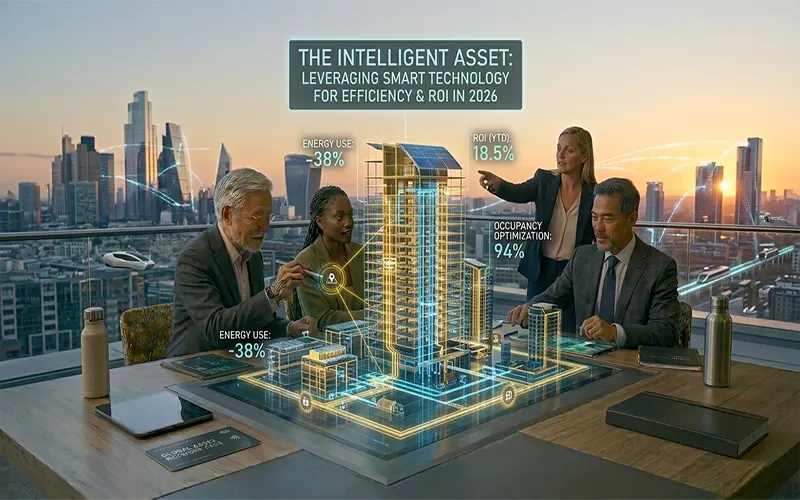
In 2026, a building’s “Digital Twin” is the central interface for property owners. This virtual replica of the physical asset is fed by thousands of IoT sensors tracking everything from air quality ($CO_2$ levels) to water flow and vibration in elevator motors.
By visualizing real-time data on a Digital Twin, owners can identify inefficiencies that were previously invisible. For instance, a Digital Twin can highlight a thermal leak in the building envelope that is causing the HVAC system to overwork, allowing for a surgical, low-cost repair rather than a system-wide upgrade.
4. Advanced Glazing: The Smart Glass Revolution
The building envelope has seen its biggest upgrade in decades through Electrochromic (Smart) Glass. As the global energy-efficient glass market hits an estimated $35.05 billion this year, smart glass has become a standard specification for “Class A” office retrofits.
Electrochromic glass automatically tints in response to the sun’s intensity. This tech significantly reduces solar heat gain in the summer while maximizing natural light, reducing the dependency on artificial lighting and HVAC cooling loads by up to 30%. While the upfront cost is higher, the lifecycle savings and the improvement in occupant comfort (leading to higher tenant retention) make it a high-ROI investment in the 2026 climate.
5. Decentralized Energy: Buildings as Grid Partners
In 2026, buildings are no longer just energy consumers; they are active partners in the grid through Demand Response programs.
- BESS (Battery Energy Storage Systems): Commercial properties are increasingly installing onsite batteries to store energy during low-cost periods (or from onsite solar) and discharge it when grid prices peak.
- Solar Integration: Beyond rooftop panels, “Solar Facades” (Building-Integrated Photovoltaics) are turning the entire surface area of a building into a power plant.
- EV Charging Integration: Smart buildings now manage EV charging loads dynamically, ensuring that a fleet of charging cars doesn’t create a massive demand charge on the building’s monthly bill.
6. The Financial Case: Legacy vs. Smart Ops
The financial disparity between “legacy” and “smart” buildings has reached a breaking point. Investors now view energy data as a proxy for management quality.
Legacy Building Ops vs. 2026 Smart Building Ops
| Feature | Legacy Operations | 2026 Smart Operations |
| Maintenance | Reactive (Fix when broken) | Predictive (Fix before failure) |
| Energy Usage | Scheduled (9 AM – 5 PM) | Dynamic (Occupancy-driven) |
| Data Visibility | Monthly Utility Bill | Real-time Circuit-level Dashboard |
| Grid Interaction | Passive Consumer | Active Partner (Demand Response) |
| Asset Value | Market Average | Green Premium (+15-30% Valuation) |
The Future-Proof Portfolio
The 2026 winner in commercial real estate is determined by a building’s “digital readiness.” By investing in predictive AI, IoT-driven Digital Twins, and high-performance envelopes like smart glass, property owners aren’t just saving on utility bills—they are insulating their assets against regulatory risk and market obsolescence. In an era of volatile energy prices, the most “intelligent” building is also the most profitable one.