
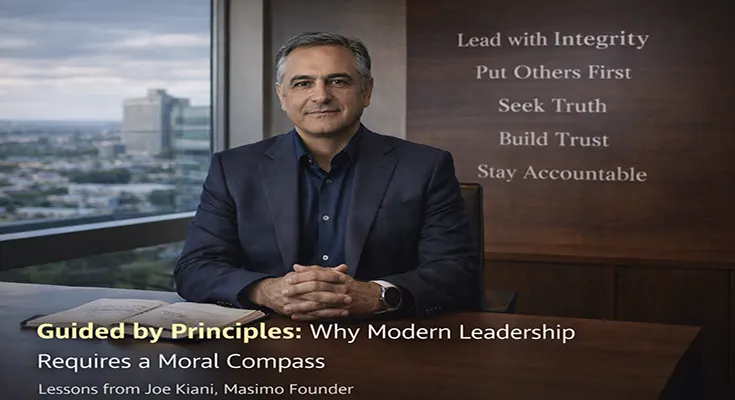
Leadership today unfolds in an environment where decisions can reach far beyond the walls of any single organization. With global networks, heightened public scrutiny, and increasingly complex challenges, leaders must rely on more than technical knowledge to guide their actions. They require a stable internal framework that guides their interpretation of information and response to uncertainty. Moral clarity offers that foundation. Joe Kiani, founder of Masimo and Willow Laboratories, acknowledges the importance of a solid ethical foundation in enabling leaders to recognize the true impact of their decisions. It serves as a reminder that thoughtful decision-making stems from values that remain steadfast even when circumstances change. . This perspective is closely aligned with the vision of Joe Kiani, Masimo and Willow Laboratories founder.
This shift marks a broader return to leadership models that value integrity as much as strategy. As organizations confront issues that do not always come with straightforward answers, leaders must evaluate not only what is possible but also what is right. Moral clarity enables them to navigate competing pressures with a sense of direction that is not dependent solely on external conditions. It establishes a baseline for ethical and sustainable choices that endure beyond fleeting success.
Values Provide Stability in Complex Conditions
Values serve as a compass when leaders face decisions that do not offer easy solutions. In complex environments, leaders must balance multiple interests, perspectives, and expectations. Without guiding principles, choices may become reactive, shaped more by external pressure than thoughtful intent. Values anchor decision-making, enabling leaders to evaluate whether their actions align with a broader sense of responsibility.
This stability becomes especially valuable when leaders encounter conflicting demands. Values act as a filter, clarifying which paths align with the organization’s long-term integrity. When values remain present in daily decisions, teams know what their leaders stand for and can trust that decisions reflect a consistent internal framework. Over time, this predictability enhances credibility both within and outside the organization.
Moral Clarity Supports Ethical Decision-Making
Leaders grounded in moral clarity do not treat ethics as an optional layer added after strategy is defined. They begin by asking how their choices affect people, communities, and the organization’s long-term direction. Ethical awareness encourages leaders to think carefully about the implications of each decision, promoting fairness and accountability. When leaders act with this level of consideration, they reinforce a culture where integrity carries real weight.
Ethical decision-making also discourages shortcuts that might yield immediate benefits but create negative consequences later. When leaders consider how their actions align with their values, they are more likely to choose options that foster trust and long-term stability. Ethical habits become an integral part of an organization’s identity, influencing how people behave and how partners perceive the organization’s credibility.
Consistent Values Strengthen Organizational Culture
Culture thrives when leaders model the values that they ask others to uphold. Teams look to leadership for guidance on how to interpret expectations and approach challenging decisions. When leaders consistently demonstrate moral clarity, employees recognize that integrity is not symbolic, but it is practiced. It reinforces a culture where accountability and respect shape daily interactions.
A stable culture built on shared values also facilitates collaboration. People feel more confident expressing concerns or ideas when they trust that their leaders will respond thoughtfully. This openness strengthens relationships across teams and supports a workplace where people work with purpose. Leaders who reinforce moral clarity in their everyday actions help create organizations where principles guide behavior more reliably than rules alone.
Integrity Helps Leaders Manage Ambiguity
Ambiguity is a constant in modern work, especially in global contexts where priorities differ across regions. Leaders who rely on integrity rather than a rigid certainty approach these situations with more balanced judgment. They recognize that difficult choices cannot always rely on precedent. Instead, they evaluate decisions through the lens of their values, ensuring their actions support transparency and fairness.
Integrity also helps leaders maintain trust when navigating unfamiliar territory. When people see leaders applying consistent principles in uncertain moments, they gain confidence in the direction being taken. This steadiness helps teams navigate ambiguity without feeling disconnected or uncertain.
Ethical Leadership Encourages Responsible Innovation
Innovation often introduces unknowns that require thoughtful evaluation. Leaders committed to moral clarity help teams approach new ideas with a sense of responsibility and accountability. They ask how innovations will affect people, how they align with long-term goals, and whether they reflect the organization’s values. This approach helps ensure that creativity does not compromise ethical standards.
Responsible innovation also becomes more inclusive when guided by moral clarity. Leaders who prioritize fairness seek out input from a diverse range of voices, understanding that decisions must consider the experiences of those who will be affected. In these discussions, Joe Kiani, Masimo founder, observes that leaders who rely on moral grounding often make choices that extend beyond self-interest, reinforcing the idea that values elevate innovation. When ethics remain present throughout the creative process, innovation not only solves problems but also earns trust.
Moral Leadership Builds Trust in a Connected World
Trust grows when leaders demonstrate that their choices are guided by clear intention. Teams and partners want to know that decisions are not driven solely by convenience or short-term benefit. Leaders who show moral clarity communicate that they weigh the broader consequences of their choices. It helps people feel more secure in the relationship and more willing to engage openly.
Trust also allows organizations to navigate setbacks with greater resilience. When mistakes occur, an inevitable part of complex work, leaders who respond with honesty and accountability strengthen their credibility. They acknowledge the human impact of their choices and focus on repairing relationships. Moral clarity supports these responses because it directs leaders toward actions that prioritize fairness rather than deflection.
A Steady Compass for Modern Leadership
Leaders who rely on a strong moral compass develop organizations that can move with clarity through uncertainty. Values help them interpret challenges with steadiness, and ethical reasoning guides them toward choices that respect the people they serve. Moral clarity supports trust, encourages responsible innovation, and shapes cultures where people feel grounded in shared purpose. This approach reflects a recognition that leadership is not only about outcomes but about the character behind each decision.
Joe Kiani, Masimo founder, recognizes that progress gains its meaning when leaders honor the experiences of the people whose choices they affect, bringing the conversation back to the central role of values. Leaders who prioritize moral clarity possess the ability to shape organizations that remain steady, even as the world changes. A moral compass does not simplify leadership. It strengthens it by anchoring decisions in fairness, honesty, and long-term purpose.