In 2026, the definition of a “local directory” has undergone a radical transformation. We have moved past the era where directories were merely digital phonebooks used to maintain “NAP” (Name, Address, Phone) consistency. Today, local directories serve as the primary ground-truth data sources for Large Language Models (LLMs) and AI-driven Search Generative Experiences (SGE).
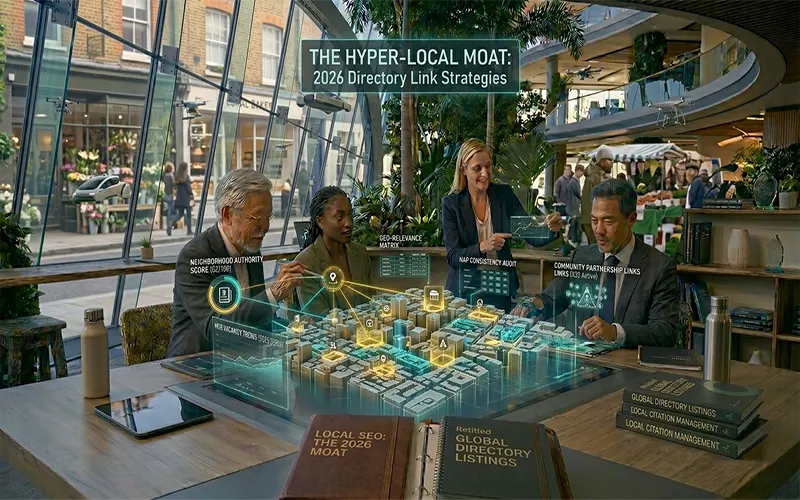
When a user asks their AI assistant, “Which boutique hotel in downtown Austin has the best rooftop bar and is open now?” the AI isn’t just “googling” a list; it is querying a web of verified entities. To rank in 2026, a business must build a “Hyper-Local Moat”—a dense network of directory links and citations that verify its physical existence, topical authority, and community reputation.
1. The 2026 Local Paradigm: From NAP to Entity Authority
The fundamental shift in 2026 is from Citations to Entities. Search engines no longer see a business listing as a static string of text; they see it as an “Entity” with relationships to other entities (locations, services, people, and reviews).
Google’s “E-E-A-T” (Experience, Expertise, Authoritativeness, and Trustworthiness) now applies to physical proximity. If your business is mentioned across a variety of trusted local directories, the algorithm assigns you a higher “Entity Confidence Score.” This score determines whether you appear in the coveted AI “Map Pack” or conversational search results.
Local SEO 1.0 vs. Local SEO 3.0 (The AI Era)
| Feature | Local SEO 1.0 (Static NAP) | Local SEO 3.0 (AI Visibility) |
| Primary Goal | Direct Traffic & Backlinks | Data Verification for LLMs |
| Metric | Quantity of Citations | Semantic Trust & Entity Relevance |
| Content Focus | Text-only NAP | Rich Media, Attributes & Real-time Data |
| Link Value | Domain Authority (DA) | Topical & Geographic Prominence |
2. Strategy 1: The 4-Tiered Citation Authority Model
Success in 2026 requires a structured approach to link building. We recommend a tiered strategy that moves from global trust to hyper-local relevance.
- Tier 1: Core Aggregators & Platforms: These are non-negotiable. Google Business Profile (GBP), Apple Maps, Bing Places, and Yelp. These platforms feed the foundational data to most automotive navigation systems and AI assistants.
- Tier 2: Primary Data Aggregators: In 2026, companies like Foursquare, Data Axle, and Neustar Localeze remain the “hidden” backbones of the internet, pushing your business data to thousands of smaller apps and GPS devices.
- Tier 3: Industry-Specific Authorities: These links carry the highest “Semantic Weight.” If you are a lawyer, a link from Avvo or Martindale-Hubbell is essential. If you are a contractor, Houzz and Angi are your primary authority signals.
- Tier 4: Hyper-Local Community Sites: These are the most difficult to replicate and therefore offer the strongest “Moat.” This includes local Chamber of Commerce listings, neighborhood blogs, and local event directories.
3. Strategy 2: Optimizing for AI Citations & LLM Sourcing
In 2026, directories like Yelp and Foursquare have direct API partnerships with AI platforms. To ensure your business is recommended by an AI, your directory profiles must be Attribute-Rich.
AI models prioritize “structured data.” When updating your directories, don’t just fill in the description. Focus on Attributes:
- “Wheelchair accessible entrance”
- “Eco-friendly packaging used”
- “Women-led business”
- “Quiet environment for meetings”
The more specific your attributes, the more “long-tail” AI queries you will capture. Additionally, ensure you upload High-Resolution Geo-Tagged Images. AI models now “scan” images to verify that your business matches its description (e.g., verifying that you actually have a rooftop bar).
4. Strategy 3: The Niche Pivot (Semantic Relevance)
One of the biggest mistakes in 2026 is chasing “generic” directory links. A link from a low-quality “Global Business Directory” is worth zero. Instead, the focus has shifted to Niche Semantic Relevance.
If you operate a medical clinic, being listed in a directory for “Top Pediatricians in [City Name]” provides a powerful signal to Google that you are an expert in that specific field. These niche directories often have lower Domain Authority than Yelp, but they have higher Topic Authority. In the eyes of an AI, a link from a niche-specific site is a “validation of expertise.”
5. Strategy 4: Unstructured Citations & Local Prominence
The “Moat” is truly built through Unstructured Citations. These are mentions of your business name and address on sites that aren’t traditional directories.
- Local News Mentions: Getting featured in a “Best New Businesses in [Neighborhood]” article in a local digital newspaper.
- Sponsorship Pages: A link from the “Sponsors” page of a local Little League team or a high school theater program.
- Neighborhood Blogs: Mentions in hyper-local sites like Nextdoor or “Mom Blogs” specific to your zip code.
These links prove to search engines that your business is a pillar of the physical community, making it the “logical” choice for a local search query.
6. Operationalizing the Strategy: Manual vs. Automated
The 2026 workflow for local link building is a hybrid one.
Automated (Scalability): Use tools like Yext, BrightLocal, or Whitespark to manage Tier 1 and Tier 2 citations. These tools ensure that if you change your phone number, it updates across 100+ sites instantly, preventing “Data Conflict” which can tank your AI rankings.
Manual (The Edge): Tier 3 and Tier 4 links must be earned manually. This involves reaching out to local editors, joining the Chamber of Commerce, and negotiating sponsorships. This manual effort is what creates the “Moat” that competitors using only automated tools cannot cross.
7. Building the Moat
Building local directory links in 2026 is no longer a “set it and forget it” task. It is an ongoing process of Entity Verification. By moving through the 4-tier model and focusing on rich, attribute-heavy data for AI models, you create a digital presence that is both resilient and authoritative. In an era of AI-driven search, the business with the most verified “Local Entity” wins.