
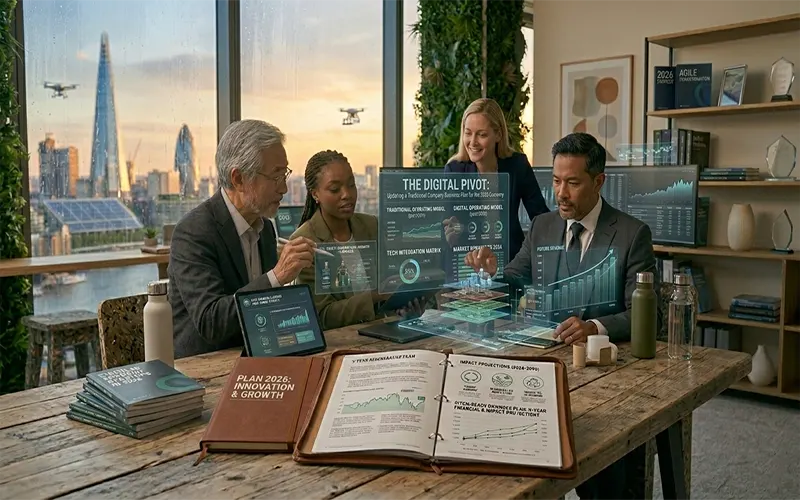
By 2026, the term “digital transformation” has shed its status as a buzzword and emerged as a baseline for survival. We have entered the era of the Embedded Economy, where artificial intelligence, cloud-native architectures, and real-time data flows are no longer “IT projects”—they are the central nervous system of every successful enterprise.
For traditional companies—the manufacturers, wholesalers, and professional service firms that built the analog world—the 20th-century business plan is now a liability. A traditional plan assumes stability and linear growth; a 2026 digital-first plan assumes volatility and exponential efficiency. To remain competitive, leadership must pivot their strategic roadmap from a static document to an agile, technology-driven manifesto.
1. Modernizing the Value Proposition: From Products to Experiences
In the traditional model, value was created by manufacturing a product or providing a manual service. In 2026, value is created through Hyper-Personalization and Connectivity.
Updating your “Company Description” and “Market Offering” requires shifting from a product-centric view to a customer-obsessed, digital-first view. If you sell industrial pumps, you are no longer just a hardware provider; you are a “Predictive Water Management Service.” By embedding IoT sensors and AI-driven maintenance alerts, you transform a one-time transaction into a high-margin, recurring-revenue digital experience.
Traditional vs. Digital-First Business Plan Components
| Traditional Component | Digital-First Update (2026) |
| Sales Strategy | Relationship-based / Manual Outreach |
| Operational Plan | On-premise servers & Manual workflows |
| Competitive Advantage | Market Longevity & Physical Assets |
| Success Metrics | Quarterly Revenue / Net Profit |
2. The Digital Infrastructure Audit: The Core Operational Update
The “Operations” section of your business plan likely focuses on physical locations and headcount. A modern update must prioritize Infrastructure Resilience.
- Cloud-Native & API-First: Legacy on-premise servers are the “technical debt” that kills speed. Your plan must detail a migration toward a modular, cloud-native architecture. This allows your business to plug into third-party AI tools and data ecosystems seamlessly via APIs.
- Zero-Trust Cybersecurity: In 2026, a data breach isn’t just an IT issue; it’s a brand-killing event. Your business plan must define Zero-Trust protocols (never trust, always verify) as a foundational pillar. This ensures that as your workforce goes remote or hybrid, your intellectual property remains shielded.
3. Workforce & Cultural Transformation: Hiring “AI Orchestrators”
The “Organization & Management” section of a traditional plan focuses on hierarchy. A 2026 update focuses on Agility and Upskilling.
The goal is no longer just to find “experts” but to develop AI Orchestrators. These are employees who understand their domain (be it accounting, logistics, or sales) and know how to use AI agents to 10x their output. Your plan should include a specific “Digital Talent Roadmap” that addresses:
- Skills-Based Hiring: Prioritizing technical adaptability over traditional credentials.
- Upskilling Budgets: Allocating significant resources to train legacy staff in AI-human collaboration.
- Decentralized Decision Making: Using real-time digital dashboards to push decision-making power to the “edges” of the organization rather than waiting for top-down approval.
4. Marketing 4.0: The Omnichannel Funnel and Agentic Sales
Traditional marketing plans often rely on broad-reach advertising. In 2026, the focus must shift to First-Party Data and Agentic Automation.
As traditional search engines give way to AI answer engines, your marketing plan must pivot.
- First-Party Data: With the death of third-party cookies, your business plan must detail how you will own your customer data (through loyalty programs, direct-to-consumer apps, or gated content).
- Agentic Customer Journeys: Use AI agents to handle the entire top-of-funnel experience—answering complex queries, scheduling demos, and personalizing follow-ups 24/7 without human intervention.
- Omnichannel Integration: Ensuring that a customer’s experience is identical whether they interact via a VR headset, a mobile app, or a physical storefront.
5. Financials & The “New ROI”: Redefining Success
The “Financial Projections” section of a traditional plan often views technology as a “Cost Center.” A digital-first plan views it as a “Margin Expander.”
To get board approval for digital transformation, you must shift your KPIs (Key Performance Indicators):
- Digital Adoption Rate: What percentage of your customers and employees are actively using your new digital tools?
- Process Automation Levels: What percentage of manual, repetitive tasks have been handed off to AI or RPA (Robotic Process Automation)?
- Innovation Spend vs. Maintenance Spend: Are you spending 80% of your budget just “keeping the lights on” (Maintenance), or are you shifting toward “Innovation” (building new digital revenue streams)?
6. The Living Document: Agile Governance
The final—and perhaps most important—update is the frequency of review. A traditional business plan is updated annually. A 2026 digital-first plan is a Living Document.
Given the pace of AI development, your strategic assumptions may change every 90 days. Your plan must include a “Governance Cadence” that allows for quarterly pivots. This agility ensures that your traditional company doesn’t just “complete a transformation” but enters a state of Continuous Evolution.
The Path to 2030
The companies that will dominate 2030 are those that took their traditional, proven business models and infused them with the speed and intelligence of the digital age. By updating your plan to reflect cloud-native operations, AI-human collaboration, and customer-obsessed digital experiences, you aren’t just modernizing—you are future-proofing your legacy.