
How to Architect a Scalable SaaS Business Plan in 2026

The AI-Driven Blueprint: How to Architect a Scalable SaaS Business Plan in 2026

In 2026, the traditional 50-page static business plan is effectively dead. For modern SaaS founders, the “plan” has evolved into a dynamic, AI-orchestrated execution engine. With the total deprecation of third-party cookies and the rise of Agentic AI, scalability is no longer a matter of increasing headcount; it is about increasing the “AI-to-Human” leverage ratio.

To build a venture-scale SaaS today, you must architect your business plan using a “Digital Twin” philosophy—where every strategic assumption is validated, monitored, and updated by AI in real time.

1. Phase 1: Market Validation via Agentic Deep Research

In 2026, market research is no longer a weeks-long manual process. Founders are now using Agentic Market Intelligence to identify gaps in the market before a single line of code is written.

  • Tools: Use Perplexity or Gemini Deep Research to perform a “Gap Analysis.” Instead of searching for “top competitors,” ask the AI to “Identify
The AI-Driven Blueprint: How to Architect a Scalable SaaS Business Plan in 2026 Read More
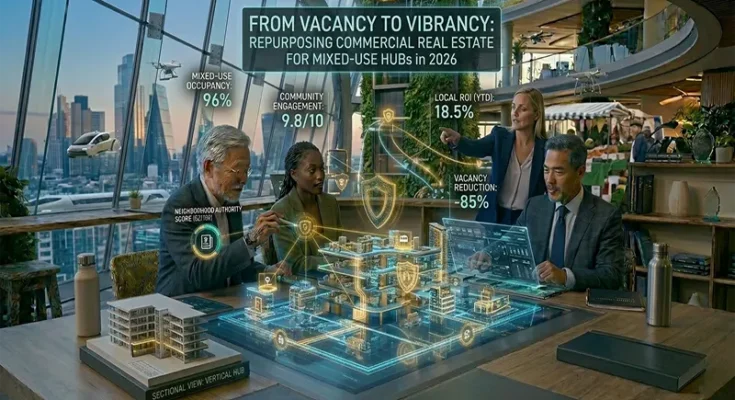
From Vacancy to Vibrancy: Repurposing Commercial Real Estate for Mixed-Use Urban Hubs in 2026

From Vacancy to Vibrancy: Repurposing Commercial Real Estate for Mixed-Use Urban Hubs in 2026

As of February 2026, the global urban landscape has entered the “Great Recalibration.” The traditional office sector, while stabilizing in “trophy” buildings, continues to face a widening divide, with lower-quality stock experiencing vacancy rates near 23% in many major metros. Single-use zoning—once the backbone of city tax revenue—is now a liability.

For property owners and municipal leaders, the path forward is no longer about waiting for a return to 2019 patterns. It is about Adaptive Reuse: the strategic conversion of underutilized commercial shells into vibrant, mixed-use ecosystems that combine living, working, and essential services into a single “15-minute” hub.

1. The 2026 Shift: Beyond Single-Use Zoning

The “Urban Doom Loop” fears of 2024 have been replaced by a more pragmatic reality in 2026. Cities like San Francisco, Chicago, and Phoenix have pivoted toward “Entitlement Smoothing,” passing ordinances that fast-track the conversion of commercial assets into residential and community spaces.…

From Vacancy to Vibrancy: Repurposing Commercial Real Estate for Mixed-Use Urban Hubs in 2026 Read More
A Complete Guide to Business Insurance in North Dakota for Small Business Owners

A Complete Guide to Business Insurance in North Dakota for Small Business Owners

Running a small business in North Dakota requires resilience, planning, and a clear understanding of risk. From harsh winters to changing regulations and unexpected accidents, business owners face challenges that can disrupt operations and threaten financial stability. Business insurance plays a vital role in protecting companies of all sizes by providing a safety net when unforeseen events occur. This complete guide explains business insurance in North Dakota in a clear and practical way, helping small business owners make confident decisions that support long term success.

What Business Insurance Means for North Dakota Entrepreneurs

Business insurance is a collection of coverage options designed to protect a company from financial losses. These losses may come from property damage, legal claims, employee injuries, or interruptions to daily operations. In North Dakota, the need for insurance varies by industry, location, and business structure, but the goal remains the same. It helps businesses recover quickly …

A Complete Guide to Business Insurance in North Dakota for Small Business Owners Read More
The Fortified Link: Secure Affiliate Management for Financial Services in the Privacy-First Era of 2026

The Fortified Link: Secure Affiliate Management for Financial Services in the Privacy-First Era of 2026

By February 2026, the digital landscape for financial services has reached a critical inflection point. The final, total deprecation of third-party cookies across all major browsers, combined with the rise of hyper-sophisticated AI-driven fraud, has turned “affiliate marketing” into a high-stakes cybersecurity function.

For banks, fintechs, and insurance providers, a leaked or hijacked affiliate link is no longer just a marketing glitch; it is a potential compliance failure and a gateway for financial crime. Managing these links now requires a “Zero Trust” architecture that prioritizes data integrity, regulatory compliance, and server-side control.

1. The 2026 Security Crisis: Cookies are Dead, Fraud is AI-Powered

The “perfect storm” of 2026 consists of two primary threats. First, the Cookie-less Reality: With 95% of browser traffic now restricted by privacy-first algorithms like Intelligent Tracking Prevention (ITP), traditional client-side “pixel” tracking is effectively blind.

Second, the AI Fraud Explosion: Fraudsters now use Agentic …

The Fortified Link: Secure Affiliate Management for Financial Services in the Privacy-First Era of 2026 Read More
The Intelligent Asset: Leveraging Smart Building Technology for Energy Efficiency and Commercial ROI in 2026

The Intelligent Asset: Leveraging Smart Building Technology for Energy Efficiency and Commercial ROI in 2026

In the commercial real estate landscape of 2026, the term “smart building” has transitioned from a luxury designation to a fundamental requirement for asset liquidity. As we navigate a year where natural gas spot prices have surged—averaging roughly $4.31/MMBtu—and electricity demand continues to climb due to the proliferation of data centers and AI infrastructure, energy efficiency is no longer just a “green” initiative. It is a core strategy for operational survival and portfolio valuation.

Today’s most successful property owners are no longer managing static structures; they are orchestrating intelligent ecosystems. This guide explores the technologies driving energy efficiency and the measurable ROI they deliver in the current 2026 economy.

1. The 2026 Energy Mandate: Compliance as a Catalyst

The primary driver for smart technology adoption this year is the convergence of high energy costs and aggressive regulatory frameworks. In the European Union, the Energy Performance of Buildings Directive (EPBD)

The Intelligent Asset: Leveraging Smart Building Technology for Energy Efficiency and Commercial ROI in 2026 Read More